Who’s Your Data? (How to Properly Use Business Metrics)

So a few weekends ago I was hanging out with my dad, and he said to me…

“I have so much to do today, I don’t even know where to start.”

So you know what he did? He ignored it all and went to a garden show with my son and I instead!

So did he finish his to-do list that day?

Probably not. But you know what he DID do? Spent time with his son and grandson. That’s way more valuable and important than cutting the grass! PLUS we both bought some SWEET plants too :-)

Now how does this apply to business?

Stick with me here…running a business involves a lot of NUMBERS; metrics, KPIs, and the like…and man can it be overwhelming.

You can get paralysis by analysis and start to feel like my dad on that Saturday when we ended up at the Garden Show.

Data EVERYWHERE…

Now the question you have to ask is this; with all that data at your fingertips, do you USE it to accomplish something REAL and VALUABLE, or do you get distracted by it, wasting time dwelling on a stupid number?

Or worse yet, do you find empty distractions to avoid the flood of metrics? (Enter Snapchat and Facebook)

In this post I’m going to clarify just WHAT to do with all these numbers, why they exist, and just exactly how you can use them to WIN. And it doesn’t matter what numbers your business keeps track of and holds you accountable for. It all applies here!

So the logical place to start then would be…

So What’s with all the Numbers Anyway?

We all WANT to win. We mean the best with the actions that we take, but so many of those actions actually lack serious focus because they are about a damn number, and not about WHAT IS REAL.

The overall POINT to business is to win. No one goes into business to break even, and certainly no one goes in to lose (money).

Save your money laundering comments plz!

So with making money as the goal, things quickly move to tracking numbers to measure success. Metrics. Stats.

These numbers mean a lot because they can show you of an area of weakness, or strength, or opportunity. Analytics are important because they tell you the story that your eyes can’t see.

BUT…Data, organized into what generally becomes a spreadsheet or PowerPoint, really only does one thing…

What Exactly is Your Job Anyway, Data?

To INFORM. That’s it.

Analytics tell the story that your eyes can’t see.

Data will tell you more of the story, and shed light in areas that you previously didn’t know existed, but the impact stops there. Numbers don’t do anything…

As in: Don’t DO anything.

They are merely the results.

Measure any number you want.
Make beautifully designed spreadsheets.
Use some new system or app.
Compose yet another PowerPoint…

And nothing happens except people know more numbers. And you can probably vouch for us all in saying that the last thing we need to do is memorize more numbers!

Besides…

There’s REALLY Only 2 Goals in Business Anyway (read more about that HERE)

Goal #1 Sell to more customers (Conversion)
Goal #2 Sell more product to the existing customers (Dollars per Transaction)

Those two things can be said many different ways, but the principles stay the same: Increase number of customers that make a purchase, and/or increase the amount of items/money that the customer purchases/spends.

OK, so what can you ACTUALLY do to cause more of each of these two things?

Hint: Numbers ain’t it.

The True Secret to Winning

So there is ONE thing, that if you get more in tune with, will cause winning. Lots of winning. That is, if you really devote attention to it.

This thing isn’t actually a thing.

It can’t be looked up, can’t be researched, and it’s NOT any sort of data. And, its different with YOU than it is with me….

What is it??? What’s the thing that transcends all the supposed precious data?

It’s easy…THEM.

YOUR TEAM.

This group is far more powerful than you’ll ever know, and the impact that your words has on others cannot be understated.

And the words that you choose with your team will be different than the words I choose with my team.

But…

When those words are YOURS, and you are having fun, and loving the things that you do, WATCH what happens! Oooo it’s like magic. All these numbers…all this “DATA”… it starts to turn THE COLOR OF MONEY :-)

Ok so let’s get to it…

So how do you tap into this TRUE secret to winning? For starters…

Data should RARELY be the topic of conversation.

Any kind of data. Leave it out of the next conversation that you have with a teammate and instead talk about the things that matter (we’ll get to the specifics of that in a sec).

What to do with the Mountain of Data

The numbers, metrics and stats truly are EXTREMELY important…

I know, I know… I have been bashing them this whole time right? But it’s only so I can make THIS POINT:

We just use numbers as a tool that they weren’t intended to be.

Numbers don’t lead people.
Numbers don’t inspire people.
Numbers don’t motivate people.

Leaders do all those things…Its the Leader’s job to find self-motivated people.

“If you want motivated people, you have to find them, not motivate them.”

Leadership is sparking change in results by changing attitude, adding inspiration, holding accountable…in short, it’s changing how a situation occurs to them.

You can’t do that by “reporting the news” and just telling them numbers. The more numbers you report, the more they will; fall asleep…roll their eyes…nod their head to get you to stop talking.

In short…

The more numbers you report, the more they stop following you.

Ok so leave the metrics and KPIs out of the conversation, got that…so what should I do with them all then?

Simple. Use data for what it was intended to do in the first place, to inform you.

Study the data to the point where you know the key metrics off the top of your head. Again, these numbers ARE very important!

You need to know them because they tell you the things that you can’t see. The things that go on in your absence. The things that you do but don’t realize that you do. The things that you need to start doing, or the actions that you need to adjust.

They matter because they measure the things that you do. But that’s just the thing, they MEASURE. They don’t DO. They don’t inspire. They don’t lead.

So Let’s Get to What it is That You Actually Do

RECAP: So the true secret to wining is your team, and the numbers ARE actually important, but you shouldn’t talk about them because they are designed inform.

Got it.

OK so what do you talk about?

Can’t talk about numbers, so instead, talk about what YOU want to talk about?

OH WAIT! NO…

Maybe you should talk about what THEY want to talk about.

Yep…

In order for you to improve their performance, you first need to know how they perceive their performance.

This is going to sound CRAZY, but it’s true…

The more you listen to your team, the more they tell you.

So, as you allow them to talk, they will TELL you the area that they need your guidance in. The area that your expertise is needed, the thing that they got lazy with, or the behavior that they weren’t taught.

They don’t come straight out and TELL YOU, but they tell you clear enough to catch every time, as long as you allow them to.

Story Time

So let me tell you a story to illustrate this point.

I was in a phone conversation with a member of my team, and he had just talked for about 2 minutes straight. Drawing off the things that he had said, I had five or six areas that I could use to teach.

I actually started my side of the conversation with a long pause, and something to the tune of, “Ok dude, hang on here, I’ve got a ton of things I can teach you, but I need to find my place to play…”

Then another long pause while I thought.  He started talking to fill up the silence, and about five seconds into that, it hit me like a ton of bricks!

I interrupted him and I said…

“Hang on, man. Hang on…I actually have a question for you. I have a question that I actually have never asked you for as long as you’ve worked for me. And it’s a question that actually starts with an apology…”

He says, “Apology? For what?”

I replied, “An apology because it was probably the first question that I should’ve asked you when I shook your hand after you got realigned to work on our team. But I never asked it.”

Confused, he just says, “…OK?”

Then I asked the question, and it may come as a shock to you…

I asked, “Did anyone ever train you for the job that you have?”

Mind you, I had just FINALLY figured out that he hadn’t been trained properly after about 2.5 months of working together. But I wasn’t exactly sure the full extent.

He was hesitant to answer the question. Naturally.

So what did I do? Tell him that he can trust me? Or worse, rattle off a ton of numbers that “prove” why I asked the question?

NO!

I apologized.

I apologized for the fact that it took nearly three months for me to ASK him, and for me to REALIZE it. I owned the fact that he was untrained and thrown to the wolves over a year before he started to even report to me!

Was it ALL my fault? WHO CARES! He’s a member of my team and he was NOT TRAINED.

Then what happens next is where the magic is. This is what it’s all about!

He paused, and then he did the most important thing that a person in a business relationship can do. He opened up to me.

He said simply, “No.”

From there you know what happened? We began to build a connection. We had a REAL conversation as business partners that started like this…

Alright, I’m Going In!

Real quick, we traced back his lineage in the company, and I found the area that I had gotten confused about with his training (or lack-there-of), and I apologized again.

I had some things on my mind from his rant earlier (the one where there was 5-6 things I wanted to teach him), but first I asked him if he had anything left on his mind.

He said “No not really…” in a way that was vulnerable, and unsure of where this was going.

I replied, standing up from my office chair, “Alright dude, then I’m going in!”

From that point I did the talking, and I was passionate. Heated. Not AT him, but in general. I was fucking pissed!

At what we’d done to him.
At the fact that I missed it for almost 3 months.
For not having asked him about his training on day onw.
And…at some of the things that he had said earlier (his excuses).

When I say I went in, I mean I WENT IN.

It was amazing. It was inspiring. It was LEADERSHIP.

The reason I describe my side of the conversation like that is not because of ego. I don’t think I’m great, trust me. I say that because of the result of the conversation.

What is that result?

That we now have the chance to…

Build Something Beautiful (Major Event Creation)

The relationship between two human beings is such an interesting thing to be apart of. Some people you CLICK with as soon as you meet them. With most others (for me anyway), it’s awkward conversation about the weather at first.

The thing that I want to talk about is how a major event can happen, and then people are different around each other. It’s often expressed as “It actually brought us closer together.

As a leader, creating these major events is how the relationship (partnership) grows. It’s how to improve things!

All those NUMBERS we were talking about earlier, they inform you as to where there is a possibility to create this major event.

I had now created that major event with this person, and he went from “employee” to “partner”.

I went from “boss” to “leader”.

We started the journey to building something together…

Something beautiful. A badass business relationship that will lead to a ton of winning.

Mind you that even though this feels HUGE, it’s really not. This is THE START. This is where the work begins.

Also needs to be pointed out that we didn’t talk about a single number this whole conversation, except at the very beginning of the conversation. I asked him about a number that he didn’t know. I DID know them though, and when I asked him about them, I was able to use the #1 Leadership Tool: Slower is Faster with People, to see that he wasn’t trained!

The Moral (People Fix it All)

This will be short…

The numbers don’t move the numbers, so don’t WORRY about the numbers.

Actions move the numbers, so pay attention to the actions.

BUT…

People take the actions, so spend the most time here…with your team.

Invest in the people, the numbers will start to take care of themselves. As things improve, you can lead the team from good numbers to great numbers.

Wrap It Up (and put a bow on it)

This post covered a wide range of topics and concepts. Let me stack them up and put a bow right on top!

  1. There’s probably too much data – We have it because we want to win!
  2. We then get distracted by the data – We think it’s the point
  3. We then try to work on the data…unsuccessfully (because it’s not the point)
  4. Data is really just there to inform…it tells you things your eyes can’t see
  5. Know the data! – It IS actually important
  6. Don’t talk about the data – Reporting the news bores people
  7. Build a connection with your team
  8. Listen more than you talk – 2 ears, 1 mouth
  9. When you do talk, don’t talk about data – It’s in there twice I know
  10. Find an area to make an impact by creating a “major event”
  11. Go slow, because SLOWER IS FASTER WITH PEOPLE
  12. People fix it all – Add value to them, and they change numbers and metrics

Keep working on being you. Not a better you, not a different you…the perfect you that you already are. Have fun, work hard, and TEACH!

-NG
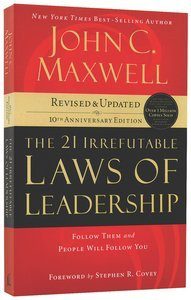
21 Irrefutable Laws of Leadership Chapter Summary

The 21 Irrefutable Laws of Leadership Chapter Summary.

Here is the complete 21 Irrefutable Laws of Leadership Chapter Summary. The summary contains the tagline for each of the 21 Laws, as well as a short excerpt on each.

21 Irrefutable Laws of Leadership list
A copy of the timeless leadership book “The 21 Irrefutable Laws of Leadership” by John Maxwell

When it comes to Leadership, there is one man that is highly regarded as THE expert. His name; John Maxwell. His timeless book, “The 21 Irrefutable Laws of Leadership” is one that has had a profound impact on many lives, including my own.

Maxwell’s well written stories and examples will guide you through a period of great personal growth. You will learn about a Law that falls within your natural strengths, and as a result it allows it allows you to improve upon that skill set. You will also learn about Laws that you may often overlook thus allowing you to spot an area of weakness, and therefore shore up that “blind spot”.

The premise of this 21 Irrefutable Laws of Leadership chapter summary is there are 21 “Laws” that are universally true no matter what area of society you are a leader in. The book covers one law per chapter. Here we review each quickly with a 21 Irrefutable Laws of Leadership chapter Summary.

Here is the 21 Irrefutable Laws of Leadership Chapter Summary.

  1. The Law of the Lid
    -Leadership Ability Determines a Person’s Level of Effectiveness
    Brothers Dic and Maurice came as close as they could to living the American Dream-without making it. Instead a guy name Ray did it with the company they had founded. It happened because they didn’t know the Law of the Lid.

  2.  The Law of Influence
    -The True Measure of Leadership Is Influence – Nothing More Nothing Less
    Abraham Lincoln started with the rank of captain, but by the the the war was over, he was a private. What happened? He was a casualty  of the Law of Influence.
  3. The Law of Process
    -Leadership Develops Daily, Not in a Day
    Theodore Roosevelt helped create a world power, won a Nobel Peace Prize, and became president of the United States. But today you wouldn’t even know his name if he hadn’t known the Law of Process.
  4. The Law of Navigation
    -Anyone can Can Steer the Ship, but It Takes a Leader to Chart the CourseUsing a fail-safe compass, Scott led his team of adventurers to the end of the earth – and to inglorious deaths. They would have lived if only he, their leader, had known the Law of Navigation.
  5. The Law of Addition
    -Leaders Add Value by Serving OthersWhat kind of Fortune 500 CEO works on a folding table, answers his own phone, visits hourly employees as often as possible, and is criticized by Wall Street for being too good to his employees? The kind of leader who understands the Law of Addition.
  6. The Law of Solid Ground
    -Trust Is the Foundation of LeadershipIf only Robert Mcnamara had know the Law of Solid Ground, the war in Vietnam – and everything that happened at home because of it – might have turned out differently.
  7. The Law of Respect
    -People Naturally Follow Leaders Stronger Than ThemselvesThe odds we stacked against her in hot about every possible way, but thousands and thousands of people called her their leader. Why? Because they could not escape the Law of Respect.
  8. The Law of Intuition
    -Leaders Evaluate Everything with a Leadership BiasHow does Steve Jobs keep reinventing Apple Computer and taking it to the next level? The answer can be found in the Law of Addition.
  9. The Law of Magnetism
    -Who You Are Is Who You AttractHow did the Confederate Army – understaffed and under equipped – stand up so long to the powerful Union Army? The Confederates had better generals. Why did they have better generals? The Law of Magnetism makes it clear.
  10. The Law of Connection
    -Leaders Touch a Heart Before Ask for a HandAs the new leader, John knew that they most influential person in the organization could torpedo his leadership. So what did he do? He reached out using the law of Connection.
  11. The Law of Inner Circle
    -A Leader’s Potential Is Determined by Those Closest to HimLance Armstrong is hailed as the greatest cyclist who ever lived. People credit his toughness. They credit his brutal training. What they miss is the Law of the Inner Circle.
  12. The Law of Empowerment
    -Only Secure Leaders Give Powers to OthersHenry Ford is considered an icon of American business for revolutionizing the automobile industry. So what caused him to stumble so badly that his son feared Ford Motor Company would go out of business? He was held captive by the Law of Empowerment.
  13. The Law of the Picture
    -People Do What People SeeEasy Company withstood the German advance at the Battle of the Bulge and dashed Hitler’s last hope for stopping the Allies’ advance. They were able to doit because their leaders embraced the Law of the Picture.
  14. The Law of Buy-In
    -People Buy into the Leader, Then the VisionThey freed their nation by passively protesting, even when it cost them their lives by the thousands. What would inspire them to do such a thing? The Law of Buy-In.
  15. The Law of Victory
    -Leaders Find a Way for the Team to WinWhat saved England from the Blitz, broke apartheid’s back in South Africa, and won the Chicago Bulls multiple wold championships. In all three cases the answer is the same. Their leaders lived by the law of Victory.
  16. The Law of the Big Mo
    -Momentum Is a Leader’s Best FriendThe two-minute film was meant to show off the power if the company’s animation technology. What it did was engage the power of the Big Mo – leading to Billions of Dollars of revenue.
  17. The Law of Priorities
    -Leaders Understand That Activity Is Not Necessarily AccomplishmentThey called him the wizard. His priorities were so focused that if you give him a date and time, he can tell you exactly what drills his players we performing and why! It won him ten championships. What can the Law if Priorities do for you?
  18. The Law of Sacrifice
    -A Leader Must Give Up to Go UpWhat would you give up for the people who follow you? This leader gave his life. Why? Because he understood the Law of Sacrifice.
  19. The Law of Timing
    -When to Lead Is As Important As What to Do and Where to GoLeaders at every level dropped the ball: the mayor, the governor, the cabinet secretary, ad the president. to one of the understood the potential devastation that can come when a leader violates the Law of Timing.
  20. The Law of Explosive Growth
    -To Add Growth, Lead Followers – To Multiply, Lead LeadersIs it possible to train more than a million people around the globe? It is if you use leader’s math. That’s the secret of the Law of Explosive Growth.
  21. The Law of Legacy
    -A Leader’s Lasting Value Is Measured by Succession
    What will people say at your funeral? The things they say tomorrow depend on how you live today using the Law of the Legacy.

That concludes the 21 Irrefutable Laws of Leadership Chapter Summary

The cover of John Maxwell’s book contains his most noteworthy 21 Irrefutable Laws of Leadership quote, which states, in regards to the laws, “Follow them and people will follow you.” Therefore the wisdom found in the 21 Irrefutable Laws of Leadership Chapter Summary will help shape you into a better leader, which will consequently cause a rise in your performance, whether you are a business leader, a teacher, an entrepreneur, or a non-profit.

John Maxwell makes the bold statement that, “Everything Rises and Falls on Leadership“, and there are many more like it packed into the pages of his classic book. Here I take you through 19 of the best 21 Irrefutable Laws of Leadership Quotes.
I’ve got a post here that elaborates on each Law within the 21 Irrefutable Laws of Leadership list.
If you want a different take on leadership, then check out the leadership teachings and wisdom of Former Navy SEAL Commander, and author Jocko Willink.

21 Irrefutable Laws of Leadership List


The 21 Irrefutable Laws of Leadership List for quick reference.

Here is the complete 21 Irrefutable Laws of Leadership List and the tagline for each of the 21 Laws.

21 Irrefutable Laws of Leadership list
A copy of the timeless leadership book “The 21 Irrefutable Laws of Leadership” by John Maxwell

When it comes to Leadership, there is one man that is highly regarded as THE expert. His name; John Maxwell. His timeless book, “The 21 Irrefutable Laws of Leadership” is one that has had a profound impact on many lives, including my own.

Maxwell’s well written stories and examples will guide you through a period of great personal growth, from reading about a Law that’s one of your natural strengths thus allowing you to improve upon that skill set, to learning about a Law that you may often overlook in turn allowing you to being able to shore up a vital weakness.

The premise of The 21 Irrefutable Laws of Leadership is that there are 21 “laws” that are universally true no matter what area of society you’re a leader in. Each chapter of the book discusses one of the 21 Irrefutable Laws of Leadership.

Two important things of note regarding the language used by Maxwell;
1. These are “Laws”, not ideas or theories. John Maxwell is not suggesting that they are to be followed, he asserts them as LAW.
2. They are “Irrefutable”, hence to argue them would be pointless. Instead, embrace the Laws as you learn them, and you will be more successful.

Here is the 21 Irrefutable Laws of Leadership list, and the tagline for each of the laws.

  1. The Law of the Lid
    -Leadership Ability Determines a Person’s Level of Effectiveness
  2.  The Law of Influence
    -The True Measure of Leadership Is Influence – Nothing More Nothing Less
  3. The Law of Process
    -Leadership Develops Daily, Not in a Day
  4. The Law of Navigation
    -Anyone can Can Steer the Ship, but It Takes a Leader to Chart the Course
  5. The Law of Addition
    -Leaders Add Value by Serving Others
  6. The Law of Solid Ground
    -Trust Is the Foundation of Leadership
  7. The Law of Respect
    -People Naturally Follow Leaders Stronger Than Theselves
  8. The Law of Intuition
    -Leaders Evaluate Everything with a Leadership Bias
  9. The Law of Magnetism
    -Who You Are Is Who You Attract
  10. The Law of Connection
    -Leaders Touch a Heart Before Ask for a Hand
  11. The Law of Inner Circle
    -A Leader’s Potential Is Determined by Those Closest to Him
  12. The Law of Empowerment
    -Only Secure Leaders Give Powers to Others
  13. The Law of the Picture
    -People Do What People See
  14. The Law of Buy-In
    -People Buy into the Leader, Then the Vision
  15. The Law of Victory
    -Leaders Find a Way for the Team to Win
  16. The Law of the Big Mo
    -Momentum Is a Leader’s Best Friend
  17. The Law of Priorities
    -Leaders Understand That Activity Is Not Necessarily Accomplishment
  18. The Law of Sacrifice
    -A Leader Must Give Up to Go Up
  19. The Law of Timing
    -When to Lead Is As Important As What to Do and Where to Go
  20. The Law of Explosive Growth
    -To Add Growth, Lead Followers – To Multiply Lead Leaders
  21. The Law of Legacy
    -A Leader’s Lasting Value Is Measured by Succession

So there it is, the complete 21 Irrefutable Laws of Leadership List

As the cover about the 21 Irrefutable Laws of Leadership states; “Follow them and people will follow you.” Therefore the wisdom found in the 21 Irrefutable Laws of Leadership list will help shape you into a better leader, which will therefore cause a rise in your performance, whether you are a business leader, a teacher, an entrepreneur or a non-profit.

The one Law that you can’t miss from the 21 Irrefutable Laws of Leadership list is #1; The Law of the Lid. It follows the story of brothers Dick and Maurice and how they came as close as they could to living the american dream-without making it. Instead a guy named Ray did it with the company they had founded. It happened because they didn’t follow the Law of the Lid.

John Maxwell makes the bold statement that, “Everything Rises and Falls on Leadership“, and there are many more like it packed into the pages of his classic book. Here I take you through 19 Amazing Quotes from The 21 Irrefutable Laws of Leadership.

I’ve got a post here that elaborates on each Law within the 21 Irrefutable Laws of Leadership list.

If you want a different take on leadership, then check out the leadership teachings and wisdom of Former Navy SEAL Commander, and author Jocko Willink.

-NG

10 Steps to better Interviewing and Hiring | Win the War for Talent

If you’d like to get a Monday Morning message from me with 3 strategies to prime you for a killer week, then sign up for my free Monday Morning 3 Point Primer.

There’s nothing more important than talent selection.

If you feel stuck, and unable to enact your vision, improving your hiring is the fastest way to change the direction of the business. Hiring isn’t hard, but to many it doesn’t come naturally. It’s a skill, and just like anything else, it’s a skill that can be honed with some knowledge and a few simple techniques. I’ve got 10 steps to support you in making better hiring decisions so you can win the war for top talent.

Step #10 Don’t Take Notes
Go to the interview with no pen, no paper, no phone, and no iPad. Just you and the candidate. It  will make you much more in tune with them and their answers, and will cut down on things for them to hide behind creating a more involved conversation. The goal is to assess the candidates skills and values so that you can make a decision on whether of not your want to have them represent your company.

To get their full story, you have to be engaged in active listening and you can’t do that with your attention on a legal pad!

Now, I didn’t say not to write ANYTHING down, I just said don’t do it while you’re in the conversation. After you wrap the interview, and stand to shake their hand to thank them for their time, now is the time to get your notes going. They’re gone, and you can think clearly. Jot down your thoughts and reactions on what they said. If you have a corporate interviewing packet, now is when you fill it out. By separating the listening portion of the interview with the writing and reflecting portion of the interview, you add value to both processes.

It’s not that you can’t do two things at once, it’s just that you shouldn’t when you’re going to be making such a huge decision!

Step #9 Ask for Stories
Avoid hypothetical answers, to the point where you refuse to accept them. When the interview starts, tell the applicant that you want answers in the form of a story, and that theses stories need to be about specific events that took place.

A hypothetical answer sounds something like this; “You know how customers can be sometimes, so it’s important to stay calm, and be direct in solving their problem so they leave happy.”
That’s not actually an answer, it’s a theory. It’s a decent theory, but it says nothing about the person’s skill set and it has one mission on the mind; IMPRESS YOU TO GET HIRED.

Hypothetical answers lead you right into the trap of getting fooled into hiring someone that is not fit for the job. This is because when they talk in theories, they sound much better than they really are.

Specific answers, now those cut through the BS! To do that we’re going to do 2 simple things. First, towards the beginning of the interview, after you finish the small talk questions, tell them you’re going to get into your real interview questions and that you want them to answer by telling a story. Second, when you ask your first question, tell them the same thing again, like this; “Tell me a story about a time you had to BLANK”.

What if I still get hypotheticals? That’s fine. Nearly everyone is used to answering interview questions like that, and you’re also used to getting them! When they start a hypothetical answer, let the person talk for a minute because there’s a decent chance that they will start out with a theory, and then go into a story. This interview style is new to them, so be patient. If the specific story doesn’t come, then we’re going to intervene with a reminder to give us the story. Something like this; “Ok that sounds interesting, so tell me about a time where you did that.”

Now you’ll be getting answers that will tell you what they did, and that will be a better representation of their skill set. From there, we can make a better judgement on wether or not they are the talent that you’re looking for.

Step #8 Be a Movie Director
Ok so what do we de with these stories? We’re going to listen to what they say, and “create a movie” in our head. Use their details to set the backdrop, and set the mood. If they don’t tell you where exactly this story is taking place, ask, and be specific. Not just the job they worked at, but was it in their office? On a sales floor?  Imagine the conversations they talk about as dialogue, and immerse yourself in the characters. As the story unfolds in their words, it unfolds as pictures in your head. This is how we are going to truly know if they are going to work for us!

You’ll start to catch hypothetical answers really quick because there’s a true lack of details, and you won’t be able to create your movie.

Now for the most important reason for making a movie out of their answers. The business world is relational, and relationships are built on conversations, so if the applicant can’t craft a compelling story, then can they achieve the success that you need to have on our team?

It doesn’t matter if you’re in sales, customer service, or a hands-on trade like electrical work, if they can’t connect with people, they’re going to experience performance issues.

It takes some patience to build your movie as they narrate the story. Don’t rush it. Stay quiet, keep listening, (more on that with #6), and use some imagination and creativity. If you have any areas that need clarification, mentally lump them into two categories;

  1. CUT, CUT, CUT – The story is missing detail to a point where your movie doesn’t make sense. As the director, you intervene and bring everything to a halt. Ask the applicant to go back and fill in the missing info.
  2. Fix it in editing – The story was only lacking a small amount of clarity and you make a mental note of it, and ask the applicant to revisit it at the end.

It’s worth noting, that when asked to answer questions in the form of a story, and having you creating the movie in your head, it is very difficult for the applicant to be untruthful. The answers have to be very complex to be made into a movie, and that level of detail is almost impossible to create on the fly.

Step #7 Ask a ton of Follow Up Questions
This is the part of the interview where we get to be in control. We’re going to be looking for gaps in the story, and making them fill them in for us using the 2 styles mentioned above.

How you ask the follow up questions is much less important than actually asking them. Do it in your style. If you’re assertive, be assertive and interrupt as you ask the question sounding skeptical. If you’re gently, politely interrupt and ask for  the clarification.

When you ask a follow up, be specific in what you’re asking, but you HAVE to walk the fine line of not answering it for them.
Good Example: “OK so you’ve got this majorly stressful situation and your GM is no where to be found. So what ended up happening??
Bad Example: “OK so you’ve got this majorly stressful situation and your GM is no where to be found. So you were able to calm it all down and get the customer happy?”
See the difference? In the bad example, you set the applicant up for success. It’s going to be a good answer because you made it a good answer. In the good example, there’s no details for them to play off of. They have to continue telling their story!

The follow up questions typically take the most time to master out of all the interviewing skills, and that’s because it doesn’t feel like you’re in control of the interview, and typically if your interviewing someone, you’re used to be in control constantly!

Since you typically will do a few interviews a week, you can practice the follow up questions normal conversation, and when you do, an amazing thing will happen; people will tell you things that you can’t believe they just told you! You give them the stage to talk, and they will just keep on talking.

#6 The 4 Secrets to Amazing Interviewing
OK we’re about halfway through here, so now it’s time to give you the one piece of advice that, above all the other ones, is by far and away the most valuable! When I was taught this by one of my mentors in 2011, it forever changed my hiring ability. I actually still have the exact paper he wrote it on, and not only that, it’s actually with me in my work bag at all times. I think this piece of wisdom is THAT valuable. Now, without further adue, here are the 4 Secrets to Amazing Interviewing;

  1. Ask Question
  2. Listen 
  3. Ask Question
  4. Listen

Here is the picture of this original lesson that I got on June 30th, 2011.

That’s it. Beautifully simple. Ask a question, listen to their answer, then ask a follow up question about it, and listen to their answer, then ask another follow up question or a different question, and listen, and repeat…

#5 Allow for awkward Silence
Be Patient, and don’t rush to finish the interview. That’s when you will start to make hiring mistakes.
Now when it comes to a silence during the interview, we need to learn to love it, not fear it. Embrace it, don’t try to fill it up.

This is their interview, and that means it’s their silence. 

When it get’s quiet, stay quiet. Use the time to think, reflect, and wait for them to talk again. They will, and a majority of the time, this is when they tell you the deeper things that they don’t tell other interviewers. Many character flaws are revealed after a silence.

Alright that’s the nuts and bolts stuff. The rest of the list is much larger, broader concepts. More complex, and less actionable, but also more important!

#4 Diversity, the Yin to your Yang
This is not diversity in the sense of social diversity, it’s diversity in the sense of you need to be looking for people that have skills that compliment areas that you have a weakness. Now if you work in sales, everyone you hire needs to have sales skills, but they don’t all need to share your passion for spreadsheets and data, or have O.C.D. about paperwork like you.
If your a people-person, you need to diversify and hire a details-person. If you’re highly analytical, you need to hire someone that’s intuitive. If you’re a Gen-Xer then you need a co-leader that’s a Millennial.

#3 Job Values
What are the skills the applicant MUST have to get hired? You need a list, and it needs to be gospel. If can be as small as 3 things, it can be as many as 10, but it needs to be specific , and they have to be non-negotiable.

Don’t make “honesty” one of them. That’s obvious!

Give this list some thought, and use pencil, not pen. The list needs to evolve as you evolve. It needs to be able to shift as the world changes. If you’re in an industry where discipline is important, then “Follows the process” may be a job value. If you’re in tech, that job value will eventually lead to the death of your company because the tech industry changes extremely fast and your team needs to be able to adapt and creatively solve problems.

Job Values 2.0
What are some skills that you prefer they possess, but aren’t necessary? To ask that differently, what are some skills that you want, but are teachable? To work in tech, they have to be able to write code to work for you, but they don’t necessarily need to be a master public speaker. Maybe that is part of the job, but that’s a skill set that you can teach on the job.

#2 Alignment to The Purpose
This ALMOST made it to #1…it’s that important.
What is “The Purpose” of your company or division, and what are the “Core Values” that your team lives by?
“The Purpose” aligns the group, and the individuals align to it. It’s a statement that expresses the highest aspirations of the team, and it can never be check off as complete. It’s the direction, and the identity. It’s what you shoot for, constantly. If your a non-profit, it might be “To always be in a giving mindset”. All, and I mean ALL of your hires HAVE to align to The Purpose by nature.

If you can’t confidently state your Purpose, then you need to make that priority #1.
Click here for guidance on finding your company’s or divisions Purpose.

So how do you find out if they align to The Purpose? Subtly, that’s how. If you tell them what it is, then they will say, “Yep that’s the most important thing there is!” You’re going to do 2 things.

  1. Ask them “what are you proud of?” and then listen. After the response is complete, ask 3-5 follow up questions, and you will be able to track back through the persons values and figure out what makes them so proud, and you’ll be able to answer the question, “Do they want to [insert The Purpose here]?
  2. Tell a Purpose-laden story of your own, and once your done, ask for their thoughts on what you said. If they pick out a version of The Purpose, then you know they align to it.

#1 An Interview is an Audit of Skills
It’s not about getting a good interview, it’s about getting an accurate interview.
This is #1, because it is. As in there is no argument that I can dethrone it, because it is what interviewing is.

A good interview is their responsibility. An accurate interview is your responsibility.

All hiring mistakes, yes all, are because something  was missed, and it caused an inaccurate audit of the person’s skills. Have you ever heard someone use the cliche’ “They were a totally different person in the interview!”

It’s impossible for them to be a different person in the interview vs the person that shows up to work.

If you interview the applicant for 2 hours, and at the end can’t answer YES to whether or not they align to The Purpose, and have the job values required for success…THAT’S GREAT. All it means is they need another interview.

NEVER HIRE HASTILY. NEVER HIRE DESPERATELY. NEVER HIRE CARELESSLY.
There is nothing more important than the people that work for you.

-NJ

If you’d like to get a Monday Morning message from me with 3 strategies to prime you for a killer week, then sign up for my free Monday Morning 3 Point Primer.

To Garner Respect, Invest in others

Investing in others is the fastest way to garner respect from your co-workers and colleagues. If you happen to be a leader…investing in your followers is the one thing that will garner respect faster than any other activity!

The ROI on teaching others valuable lessons cannot be understated.

The best leaders are very intentional about the development of their people.”

Now, I want you to think about two things:
-Truly, how intentional and deliberate are you?
-How effective are your methods?

The first question isn’t about your INTENTIONS, it’s about your actions.

What is it that you DO that helps in the development of those that follow you? How do you teach? How do you EMPOWER them? The level of trust that you have in them is dictated by the quality of knowledge you gave them, and the level of understanding they took from what you taught them.


The second question isn’t about what you THINK you taught them, or what you FEEL they should already know.

Communication isn’t about what you say, it’s what they hear. Teaching is a form of communication. You present information to an employee, and they must retain it well enough to utilize it. If and when they don’t retain the info properly, YOU have done a poor job teaching (Setting clear expectations), or you’ve hired the wrong person for the job.

The level of respect that your employees have for you is directly connected to what the amount of value that you add to them through teaching. When you change a person’s path in life through the gift of knowledge, they’ll respect you for the rest of your lives.

If your employees don’t respect you, it’s because you’ve haven’t taught them well, but are holding them accountable for it. That means that you DIDN’T teach them, and are punishing THEM for it. No wonder they don’t respect you.

Adding value to an employee comes from helping them, not telling them that they get written up, and then eventually fired.
Help them. Teach them. Coach them. Then hold them accountable.

-NJ

Click here to see the 5 Super Easy Steps to Make Yourself Stress Proof