Motivation is fickle
and
Inspiration is unreliable
and
Focus can come and go
Being LEGEND isn’t about being more motivated, more inspired, or more focused. That’s because a LEGEND already knows that those things can’t be relied on.
What separates the LEGENDS from the rest of the world? ……”JUST GO”. That’s what.
It isn’t about if they feel like it, because they probably DON’T feel like it.
It isn’t about being moved to perform today because they don’t run on inspiration.
It isn’t about if they are focused on being organized, or winning, or engaging…
Nope! You want to know what makes them different?
The LEGENDS, they run on a different fuel. This fuel isn’t fickle and it isn’t intermittent.
This fuel makes THEM reliable.
That fuel they run on is…JUST GO
They JUST GO do the things they need to do. JUST GO do the things they are supposed to do. JUST GO do the the things that they are afraid to do.
That’s it. That’s the whole secret.
While the rest of the world look for inspiration on Pinterest and motivation on Instagram, the LEGEND is out of bed early taking action already.
While the ones that SAY they “want it” watch Netflix on the couch, the LEGEND is still out there grinding because there is work to be done!
The LEGENDs JUST GO. Despite how they feel. Despite what others say. Whether or not they get the credit or praise.
Today, let’s all work on being LEGEND. JUST GO. ATTACK.
“Gimme a reason to fight for you, and I’ll fight to the death for free.”
That’s a lyric from a song called High Class Catastrophe by a punk band named Hot Water Music. It’s come to mean something special to me of late.
Let me explain…
In leadership, there is a CONNECTION that we build with our followers that is hard to put into words. One that I have had the pleasure of building with many different people over my years in a leadership position.
The company I work for is special for a lot of reasons. . .
The individuality that we get to express
The competitiveness that we enjoy
The work ethic to out run all other competition
The Core Values that guide us…
But it all pales in comparison to that CONNECTION that we create with “our people”. It’s the glue that BONDS us together.
I have to admit…I had forgotten just how important it really is.
That lyric at the top in bold…It’s not just a cool way to start this post. It’s not just a great song either. It’s something that came into my life for a reason. As I began to realize how I had lost touch, and had started to get back on track with the guidance from a mentor and patience from my team, I heard that song. It was 2 weeks ago on a drive back from Lafayette, LA when I actually HEARD the lyrics.
The timing was insane because then my company’s National Sales Meeting was only a week away, and I got to be surrounded by hundreds of examples of CONNECTIONS that I had with others. I was along side six members of my team, and I got to spend time with the four mentors that influenced my life.
There’s a lesson in here, and it’s one that is, well, counterintuitive…
Slower is Faster with People
That was taught to me a few weeks ago by one of the people that I consider to be one of those four mentors that helped shape my life/career.
Slower is faster with people?? That’s a weird saying. And it sort of contradicts itself.
So what the heck does it mean?
I’ll keep it short and sweet… When you are working with a person, and you rush it, nothing really happens. You THINK you made an impact, but really, you did not. You may have said a handful of great things, or acted like you listened or understand, but if you’re in a rush, then you can’t make a connection.
Now, if you go slow, you will touch on less topics, and you won’t be able to accomplish as many things, but something special will happen. You will realize that the “topics”, and the “things” aren’t the point anyways.
What is the point?
That connection. It’s not about WHAT you teach them, or how many THINGS you teach them…No, it’s about investing in THEM. Going slow and building a relationship as well as building their knowledge base.
Reflect on those that you HAVE AN OPPORTUNITY to build that connection with.
Reflect on those that you haven’t done that with yet.
Strategize on how you can impact MORE LIVES with your teaching, mentoring, and words.
In our society, faster is becoming the new normal. Accomplishing THINGS is what seems to be cherished. But as a leader, you will never turn yourself into a mentor focusing on either of those THNIGS.
It’s about that connection.
Use this quote from Theodore Roosevelt to guide you: “No one cares how much you know, until they know how much you care.”
And . .
Give me a reason to fight for you, and I’ll fight to the death for free.
Jocko Willink is a former United States Navy SEAL commander, and author of seven books:
Extreme Ownership – How Navy SEALS Lead and Win
Discipline Equals Freedom – Field Manual
Way of the Warrior Kid
Way of the Warrior Kid – Marc’s Mission
The Dichotomy of Leadership
Mikey and the Dragons
Way of the Warrior Kid 3
He focuses on teaching the leadership principles that he learned as the Commander of the SEAL Task Unit Bruiser, where he was stationed in Iraq fighting in the Battle of Ramadi. He is the co-owner of the leadership consulting company, Echelon Front where he, along with Extreme Ownership Co-Author Leif Babin, provide practical solutions to create high performance success in professional teams.
Jocko’s most recent book, Discipline Equals Freedom: Field Manual
In Discipline Equals Freedom, Jocko hones in more on his personal methods for life, and leadership.
The book is separated into 4 parts:
Thoughts – This is where Jocko covers his personal views on many things
Actions – This is where Jocko goes more pragmatic in how he attacks life
Fuel – Feeding the Machine – Jocko’s take on food
The Workouts – Here Jocko outlines his personal workouts, and breaks them into Beginner, Intermediate, and Advanced with 4 tiers of difficulty in each
Discipline Equals Freedom is a phenomenal read, and it’s also a bad ass design.
The book is all black, with no dust cover. The pages are all black with white type, and each page has a black and white backdrop behind it. (There is a picture of two of the passages down below so you can see how the book is laid out.)
The writing style of Discipline Equals Freedom is like no book I’ve ever read…It’s almost written in poems.
The writing style is incredible, and as you read each passage, the whole book is practically narrated in Jocko’s distinct surly voice.
While Jocko is very well known for his aggressive style, rough exterior, and assertive attitude, he actually has a bachelors degree in English. This, combined with his extensive leadership experience, and take-action attitude, make him a phenomenal motivator and a role model for many.
Here are 31 of the best Jocko Willink Quotes from Discipline Equals Freedom
The Way of Discipline – “THERE IS NO EASY WAY. There is only hard work, late nights, early mornings, practice, rehearsal, repetition, study, sweat, blood, toil, frustration, and discipline. DISCIPLINE.”
The Enemy – “I know that somewhere out there, another man is also preparing. That man is the enemy.”
Where Does Discipline Come From – “If you don’t think you are disciplined: It is because you haven’t decided to be disciplined. YET.”
Overcoming Procrastination – “Stop thinking about it. Stop Dreaming about it. Stop researching every aspect of it…Start doing it. Take that first step and make It happen. GET AFTER IT.”
The Person You Can Control – “The only person you can control is you. So focus on making yourself who you want to be: Faster. Stronger. Smarter. More humble. Less ego.”
Mind Control – “You have to decide that you are going to be in control, that you are going to do what YOU want to do. Weakness doesn’t get a vote. Laziness doesn’t get a vote. Sadness doesn’t get a vote. Frustration doesn’t get a vote. NEGATIVITY doesn’t get a vote. ”
Mind Control (2)- “You are declaring martial law on your mind: MIND CONTROL.”
Destroyer Mode – “Fight weak emotions with the power of logic; fight the weakness of logic with the power of emotion.”
Here is Jocko Willink reading the passage “Destroyer Mode” from Discipline Equals Freedom: Field Manual.
Fight – “Go out in a blaze of Glory, fighting with everything you’ve got, every ounce of energy, every bead of sweat, every drop of blood – until your last breath. And then – and only then- can you stand down, put down your sword and your shield, and rest: in peace.”
Default Aggressive – I don’t view aggression as an outward attitude. I view aggression as an internal character trait. A fire in your mind that says: I’m going to win”
Nature vs Nurture – “So to me, it is not about nature or nurture: It’s about choice”
Fear of Failure – I don’t want you to overcome fear of failure. I want you to be afraid of failure.
Sugar Coated Lies – Those donuts aren’t food. THEY ARE POISON. Same with the chocolate chip cookies, the chocolate cake, the can of soda, the bag of potato chips….All that junk isn’t going to make you stronger, faster, smarter or better. It’s going to do the opposite. And you know this. YOU KNOW THAT YOU DON’T NEED ANY OF THAT JUNK.
Not Feeling It – How do I handle those days when I’m just not ‘feeling it’? Those days when I am tired or worn out or just sick of the grind…What do I do on those days? I GO ANYWAY. I GET IT DONE.
Not Feeling It (2) – Don’t really want to workout? I work out. Don’t really want to hammer on the project? I hammer on the project. Don’t really want to get up and get out of bed? I GET UP AND GET OUT OF BED.
Focus – Embed that long-term goal in your mind. Burn it into your soul….but most important: do something about it. Every day. Every day: Do something that moves you closer towards that goal – that keeps the goal in sight and in focus.
Draw Fire – “Be the one who people look to. Absorb the impact – and the negativity. Draw fire – yes: Draw (enemy) fire.
Good – “When things are going bad: Don’t get all bummed out, don’t get startled, don’t frustrated. No. Just look at the issue and say “Good.”
Every Day – “This isn’t a part-time gig. This isn’t punch the clock and go home for the day. You don’t get weekends off. No…this is an everyday gig. Everyday is a Monday…I love it.
No More – “No more excuses…Now is the time for strength. And through strength – and through will – and through unwavering discipline – I will become what I want to be. I will become who I want to be.
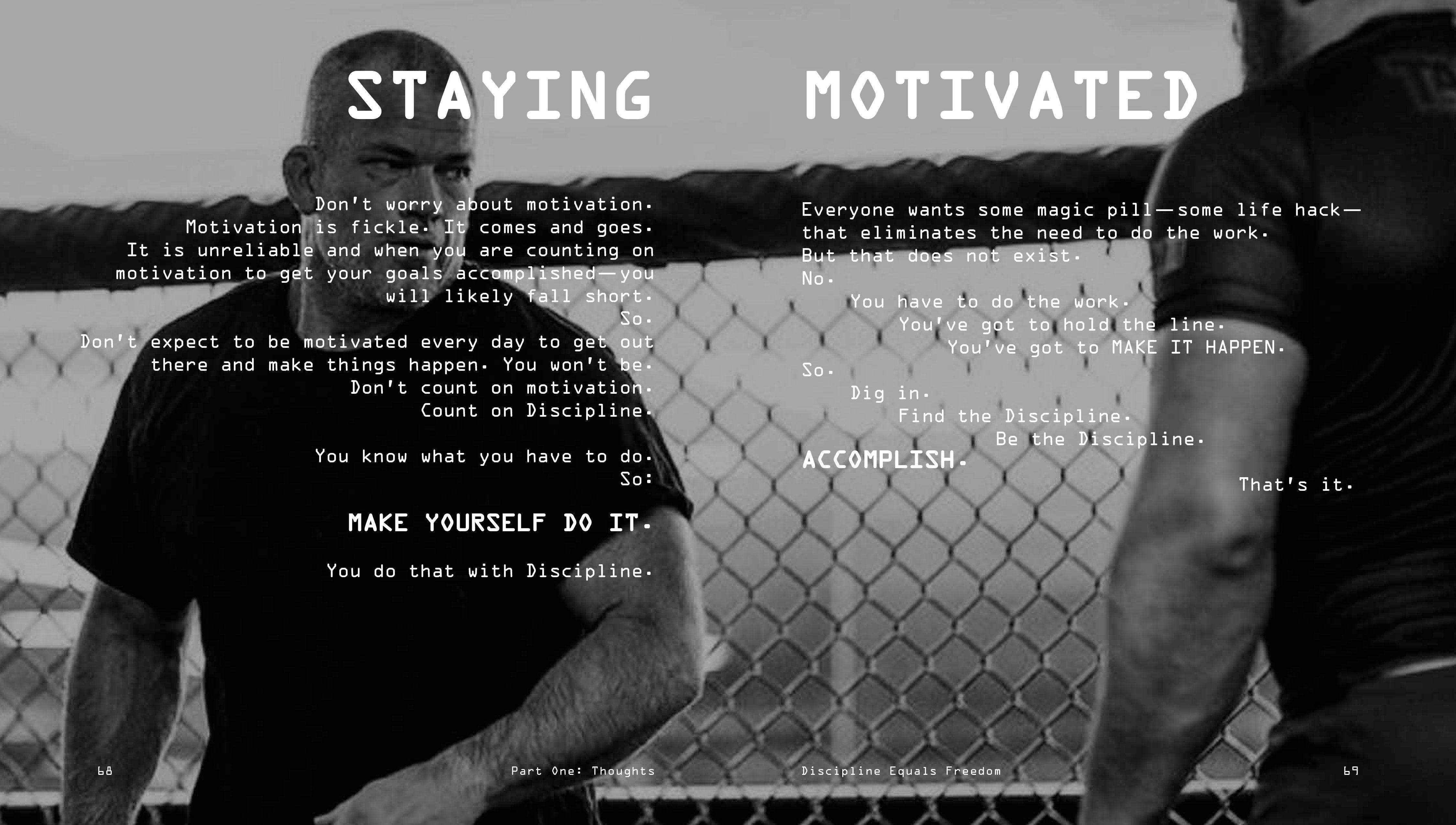
Staying Motivated – “Don’t expect to be motivated every day to get out there and make things happen. You won’t be. Don’t count on motivation. Count on discipline.”
Here is an example of two pages of Discipline Equals Freedom: Field Manual
Remain Vigilant – “It isn’t that you wake up one day and decide, that’s it: I’m going to be weak. No. It’s a slow incremental process. It chips at your will – It chips at your discipline.
Fear – “Step aggressively towards your fear – that is the step into bravery.”
Negative Talk from Negative People –“IGNORE AND OUTPERFORM.Yes. While you are over there watching me and talking about me – I’m working. Working hard. I’m taking things to the next level.”
Engage – “Weakness is strong. I must be stronger.”
Psychological Edge – “There are a slew of psychological advantages that come from early morning physical training. First, there is a psychological win over the enemy. Knowing that you are working harder than your adversaries gives you an advantage. It gives you confidence that you can overcome them in battle.”
Here is Jocko Willink reading the passage “Psychological Edge” from Discipline Equals Freedom: Field manual.
Sleep – “Go to bed at 9:55pm and you can get up at 4:55am, still get your seven hours, and be up before the enemy.”
The Workouts – “Everyone wants to know: what should a workout actually consist of? And first of all – let me say this: The most important thing to do is SOMETHING. ANYTHING.”
Addicted to Sugar – “The lies will come, and the will come from you. The lies you will tell yourself are: It’s no big deall. You can have just a little. It isn’t worth it to feel this bad. The body needs carbs. You will rationalize, and start to listen to these lies. DON’T.”
Fasting – “In this age, the food around you is actually trying to kill you. It is poison. Donuts? Poison. Soda? Poison. Potato Chips? Poison. YOU DON’T NEED IT.”
Dealing with Injuries and Illness – “If you are sick or injured, don’t use that as an excuse to skip workouts to stay in bed all day. Do what you can.”
Here I’ve got a great infographic full of great Jocko Willink Quotes from Discipline Equals Freedom.
BONUS FROM JOCKO PODCAST
Here is an excerpt from Jocko Podcast where Willink is discussing being a new leader and not knowing as much as your subordinates.
It’s been dubbed; The Leadership Comb-over.
Thanks for reading this collection of Jocko Willink Quotes Discipline Equals Freedom.
Which quote inspires you…which one speaks to you? Leave a comment below!
You can hop on Pinterest and get 50 whimsical quotes.
or….
You can google it and get About 32,400,000 results (0.54 seconds).
The issue with all those motivational quotes, is that your team has seen them before. They have googled it, and they’ve seen all the same memes that you’re looking at.
They have a Pinterest board called “Inspiration” with those same pins saved to it.
You want something fresh? You want some inspirational quotes that you can’t find on any other site?
I got you!
Here are 13 Motivational Quotes for Salespeople that you haven’t seen before!
-Don’t make excuses, because excuses don’t close deals.
-It’s hard to stop someone that doesn’t give up.
-Finite players play within boundaries; infinite players play with boundaries.
-Luck is important. It’s also a random variable, so it’s about doing everything you need to do to win, and eventually luck will swing your way.
-If you can’t join ’em. Beat ’em.
-Notice the difference between the questions “can I do this?” And “how am I going to do this?”
-A customer is the most important visitor on our premises, he is not dependent on us. We are dependent on him. He is not an interruption in our work. He is the purpose of it. He is not an outsider in our business. He is part of it. We are not doing him a favor by serving him. He is doing us a favor by giving us an opportunity to do so.
-Focus on the process, and the success will take care of itself
-Great sellers are listeners. The customer, through words and body language, will tell you what you want.
-Absent hard work, no one is really great at anything.
-I don’t need time. What I need is a deadline.
-Master your craft. Don’t let your Craft master you.
-Losers focus on winners. Winners focus on winning.
-Do the things you have to do, so you can do the things you want to do.
-There is no such thing as missed opportutnies…some else just takes the ones that you miss.
-Your ability says WIN. What does your attitude say?
-The dreams are free: Hustle sold separately
-We ben spendin two much time tryin to spel instead of tryin to sel.
-How to never lose…never quit
The list is kept to 19 because you want motivational quotes that can be motivate sales people. It doesn’t take a list of 50 quotes to get you going, and this way you don’t have to dig through some long list to find the good quotes. They’re all gems! These are quotes that you can’t find on any other site.
The Marine Corps Leadership Traits – JJDIDTIEBUCKLE
The Leadership Traits of the USMC are summed up as 14 qualities that are essential to every Marine to follow in life, and in the Marine Corps.
Since these leadership principles of the USMC are so important to each and every Marine to live daily, they have a clever acronym to remember each of the 14 leadership traits.
JJDIDTIEBUCKLE
Each letter in the acronym corresponds to the first letter of one of the 14 USMC Leadership Traits. By remembering the acronym, they will be able to recall the traits, and use JJDIDTIEBUCKLE to guide their thoughts and actions.
Justice – Being fair and consistent. Giving consideration for all sides of each decision, and having rewards and punishments based on merit.
Judgement – The Ability to think things through in a clear, and orderly fashion so as to make the right decision.
Dependability – Having the ability to be relied upon to perform duties properly, and complete a job. Always putting in best effort so as to achieve the highest standards of performance.
Initiative – Taking action even if direct orders haven’t been given and using resourcefulness to solve problems.
Decisiveness – The ability to make good decisions calmly and quickly, and announcing your decisions in a clear, direct and professional manner.
Tact – To deal with people in a manner that will maintain good relations and avoid problems. It means that you are polite, calm, and firm.
Integrity -To be honest and truthful in everything you say and do, and value sound moral principles above all else.
Enthusiasm – Performing of your duties with excitement, optimism, and willing to accept the challenges
Bearing – The way you conduct and carry yourself. Manner should reflect alertness, competence, confidence, and control.
Unselfishness – To be considerate of others, giving credit to those who deserve it. To make self uncomfortable at the gain of others.
Courage – To remain calm, even while recognizing fear. Having the strength to stand up for what is right. Functioning effectively when in immediate physical danger.
Knowledge – An understanding of science, art, and people. Knowing your job, the unit’s policies, and being informed on current events.
Loyalty – The devotion to country, and the Marine Corps. Unwavering loyalty up and down the chain of command, to seniors, subordinates, and peers. The motto of the Marine Corps is Semper Fidelis (Semper Fi), meaning “Always Faithful”.
Endurance – Mental and Physical stamina, which is measured by your ability to withstand pain, fatigue, stress, and hardship.
These are the USMC leadership principles as expressed by the acronym:
JJ DID TIE BUCKLE.
Wait Time Can Make Customers Upset, or it Can Be Used to Make an Impact
Imagine you are visiting somewhere for the first time and you walk in the lobby to someone 20 feet in front of you chewing gum and waiting for you to get directly in front of them before they will even speak to you. They take your name and tell you they will call for you (yelling for you is the most likely outcome). While you wait for the 20-30 minutes you were told would be the wait time, no one speaks to you. No one asks if you have been there before, thanks you for giving them a shot at earning your loyalty and no one gives you a chance to ask any questions a first-time patron might have. While you wait for what seems like days you see people who came in after you go in, so you begin to think you have been forgotten, or that they called your name and you didn’t hear it. You go back to the person taking names and ask them how long it will be, they look at you with disgust and tell you, “I told you 20-30 minutes and it’s only been 15.” Now imagine how you would feel sitting down at a table or how angry you would feel when you finally get into your appointment. Think about how likely you would be to go back to this place, not likely right.
Companies spend millions of dollars figuring out how to attract customers to their business, only to mess it up when they walk in the door. You may have the best product in your category, possibly winning a customer for life as soon as they experience your food or get their hands on your item. There is one problem that you may have and it will cause people to have a negative opinion of your offering, even if it is amazing! Wait times. Waiting in your lobby to get in and spend their money will send a message to your guests, one which you may never have an opportunity to rebound from.
Ignoring the Wait Time Sends Three Messages to Your Customers
We don’t know what we are doing
The quality of staff here is poor
We don’t really care about YOU, just your money
Think about a restaurant, doctor’s office, clothing store, barber, meat counter, cell phone retailers and so on. They all have the same problem; while you wait for even a short time, it feels like you have waited FOREVER! I cannot tell you how many time, as I am sure is the same for you, that people have come up to me and asked, “how much longer?” and “how many people are in front of me?”
After hearing these questions a few hundred times I wondered if there was a way to share this information.
We tried installing TVs in the lobby with a list of people’s names on it; they didn’t read it.
We tried to pager system with vibrating “it’s your turn alarms”.
We even tried handing out notecards with estimated wait times and a few promotional items to browse while they waited.
None of these worked. We still had upset customers asking questions and sitting down with a negative attitude when it finally was their turn.
Send the Right Message to Your Customers
Communicate to them that they WANT to wait. That this wait is worth it! Over 20 years of managing stores with a lobby where customers have to wait to be assisted, I have come to one conclusion. It will instantly improve public perception and keep people from leaving, to never return. The solution isn’t rocket science. It isn’t a fancy system with pagers that vibrate when it’s their turn, nor is it a video game or trivia system for people to pass the time. The solution is simple…
TALK TO YOUR CUSTOMERS!
Talking to your customers sounds easy and plain, but it works. When I first started doing this I would walk around to each guest and introduce myself as the floor manager and would SHOW THEM where their name was on the list and give them an estimate about how long the wait would be. I would describe (not point) the person who was ahead of them in line so they knew who would be up before them. This seemed to work well, we were seeing marked improvement in customer service scores and less upset customers.
I Still Felt Like We Could do More
I tried something new. I assigned the responsibility for customer wait time frustration to the person taking the names. Their responsibility was to keep these people happy while they waited. You should be hiring quality people, not just a body to fill a spot, right? Would you trust just anyone being the first impression a potential new customer sees when they walk in? If you know that this position is important and have someone who is amazing up front, then they will have the ability to check people in AND keep them happy. I assigned my greeters more responsibility than writing a name on a list. Not only would they keep the list of people, they would also continuously check in with them. I told them I expected them to be remembered by those in line. Now they would tell each person where they were in line each time a person was pulled from line. If you were in line and 7 people were ahead of you, they would check in with you as you moved to numbers 6,5,4,3,2 and then telling you that you were next!
This may seem like overkill, but customers LOVE it!
The ONE thing to NEVER do
The greeters were also FORBIDDEN from “cattle calling” or yelling their name across the room like it was a livestock auction. The greeter should know who each person is and be able to approach them, thank them for waiting and tell them their table or salesperson or doctor will be seeing them now.
The waiting game is one you can lose as soon as your guests enter your business. You must have someone up front who CARES about how the greeting happens. Make sure they understand that when the customer finally gets past the wait and into the establishment, they should be on a first name basis with your greeter/host. Whomever you have up front CANNOT stand behind the podium growing roots in the dirt. They must walk around engaging your customers and asking them if they need anything while they wait.
As you grow your business, do you want people leaving being blown away by how tremendous your service was, running out to the door calling their friends or family to tell them they finally visited you and it was out of this world? Or, when they leave, you happen to be in the front of your business and you say “see ya next time!” and as they push the door open they say “not likely.”
The language used to describe your surroundings will become your culture.
Language is not just a form of communication. It truly shapes the way things occur to us. The term “language” refers to anything that is communicated, verbally and non-verbally. From the things that you say aloud to others, to the body language that you use to communicate. An obvious eye-roll, or a much more subtle “demeanor” given off when you harbor resentment.
The answer to “What it Reality”
The question, “What is reality”, has a vast many opinions attached to it. What is real, and what is the world/universe that we live in?
My personal favorite opinion on reality is called the “Simulation Argument”. It basically states that we are actually living in a computer simulation. Said differently, we’re an extremely complex version of The Simms. Not to dis-similar to the Matrix actually.
Now, to me, reality is something completely different, and, could theoretically be taking place in a computer simulation. If it is, it wouldn’t matter anyway, because whatever your reality is, is your reality.
My opinion on reality is that it’s in our language. What we say, is what is true. If we speak it, we make it so. When I say that “language truly shapes the way things occur to us”, what that means is that language builds your reality. Language IS reality.
Without Language, Reality Doesn’t Exist
Language is unique to humans. If we don’t have the ability to use language, we don’t have reality. Simple. Think about it, to your dog, the wood fence in the yard is just there because it’s always been there. It’s not called a fence either. It’s not called anything, because it isn’t anything. It’s just there. There’s nothing on the other side of it, or behind it, because there is no “other side” or “behind” to a dog. That’s because dogs don’t have language. Think of it a bit more complex. Dogs don’t hold grudges because grudges aren’t real. It’s just a word that humans use to describe events in the past. Dogs don’t make promises either, because there’s no such thing as a promise without the word “promise”.
So then, What Reality is Your Language Creating for Your Organization?
Your language creates either momentum or stagnation. So, on the team that you lead, the language that you use is creating a perception of the events that happen, and thus you also create a culture. If the language and verbiage you use is that of someone who thinks “Things here suck”, then your followers will soon begin to agree. That becomes their reality. When you communicate in those terms, you’re focusing on, and actively creating a culture that will become toxic, full of complaints, and eventually performs poorly.
When the language you use is that of someone who thinks “We’re great!”, then your followers will begin to agree! That becomes your reality. When you communicate in those terms, you’re focusing on, and actively creating a culture that will become special. Full of teamwork, ideas and partnerships. This is where momentum is built!
Examine the Correlation between Language, and Performance
If foot traffic is down 10% can you win? The way that situation occurs to you will determine your performance. So, your answer will create a reality that can come true. If the outlook is hopeless, then the customer service will be equally hopeless. When customer service is bad, there’s no chance to win, even if the foot traffic was up 10%, let alone down 10%. You see the correlation between the language and the performance? You see that the reality that is created in the language is one that almost ensures lack of success, so then lack of success becomes the future?
Move the language to a positive place, or your Superstars will move to a positive place.
Only hopeless individuals want to be in a workplace that has a culture that is hopeless. Talented individuals have options; job offers come easy, recruiters contact them often, and they are generally “magnetic”. Keep this in mind: The way a situation occurs will ALWAYS determine performance That can be tweaked to say; the way a team occurs will determine talent level. Or, the way a company occurs to its employees will determine turnover rate. You see how powerful language is? You see that there is no reality of “hopeless”? It’s just language creating the perception of that reality?
So How do you Change the Way The Situation Occurs?
Here’s How You Apply Language to Shape a Reality that You Want
-Before you make an effort to change performance, first consider how the situation occurs to the individuals on your team
-Listen to the teams language of how being a member of this team occurs to them
-Pay close attention to body language that also communicates how the job occurs
-Stop using descriptive language in talking about performance issues
-Instead use mental bandwidth to solve problems, not “find reasons”
-Don’t go with “what worked last time”. Use that experience to create new ideas.
-Use “we” instead of “I”, “us” instead of “you”
-Stop saying, “I can’t”. Instead say “We have a challenge.”
-Involve the team in helping to create with reality that you desire to obtain
Language is reality, and you can create any reality that you want! When you change the language, you change the way a situation occurs for the team, and then you can begin to add actionable items to improve performance.
I want to talk about a common, and sadly mistaken, business expression…going over someone’s head.
More specifically going over your boss’s head. Or for leaders, an employee going over your head.
There’s no such thing as “going over someone’s head”. If one of your employees oversteps you in the chain of command to get help, and doesn’t talk to you about it first, it’s not their fault, IT’S YOURS. The reason being, a person’s development is their own responsibility, and no one else’s. They are in charge of their own career path. So, if their leader isn’t providing the things they need to accomplish their goals, then they need to take control of that.
Here are the 4 possible reasons that someone goes over their boss’s head:
1. They’re not learning b/c they’re not being taught
-If they aren’t making progress because no one is teaching them, they need to let someone know. That someone…you guessed it! 2. They’re being treated unfairly
-No one should be mistreated, no matter what. There is no gray here. If a person is being mistreated, they need to get their supervisors boss involved. 3. They’re leader sets a bad example
-If a person’s boss breaks policy, or acts unethical then they have every right to go the leader above them. 4. They were a bad hire
-If you hire an unstable person that runs to your boss for something that never happened, then they did the wrong thing in going over you, but you goofed up by hiring them in the first place.
If you notice, the blame falls on the leader in all 4 reasons.
When a person feels that their concerns are not being properly handled, or their training and coaching aren’t adequate for them to reach their full potential, it’s their responsibility to themselves to make sure the problem gets fixed. If this means talking to the boss’s boss, then so be it, but to think that they are at fault for seeking council from someone that will help them is an ignorant way of thinking. Yes, there is a chain of command, but if there is a weak connection in 2 links of the chain, then isn’t it the responsibility of the other members of the chain to repair that connection, for the good of the group?
When the leader isn’t listening, the follower begins to look for someone who will.
When the leader has stopped listening, they’re in danger of severing the connection with the follower. Without that connection, they’re no longer a leader. They’re now just a boss…someone that others report to because of company alignment. When the leader isn’t listening, the follower begins to look for someone who will. The more talented the employee, the more options they have. other people will listen toOptions mean there is MANY other leaders out there that will be more than willing to listen.
If you ever have an employee of your that “goes over your head”, look inward, not at them. Instead of placing blame (easy to do), reflect on what caused the actions of your employee, and then take the blame. OWN IT, and then look to repair the connection with them. IT starts with an apology, and continues by asking a question, then listening. REALLY listening.
I think you will agree with me that taking the proper corrective action when a problem arises can be tough.
The issue that most leaders struggle with is detaching from the situation so they can clearly see what action they need to take.
As a leader myself, I was once guilty of this on grand scale. I had sputtered in my new role for close to a year until finally, I put my ego aside and took the one action that caused much of my success that I have experienced 6 years later. I would love to tell you that this crucial action was some ultra-impressive feat of will power. Truly, it was just putting my ego aside and asking my boss for help.
Within 3 weeks I was not only right back on course, but I was able to create serious momentum that continued to build years! I finished in the top 10 of the company for yearly sales increases the next 3 years. I also built a connection with my boss and proved that I have what it takes to improve, and ultimately win.
In this article, I will teach you about detached involvement (detachment for short) and how to use that sell to view situations more clearly so you can take the corrective action needed to get you back to winning.
The Secret Leadership Tool: Detachment
When there is an area of life that you’re experiencing a lack of performance in, being able to detach yourself from the situation will allow you to see what’s actually happening. When you’re involved in something, you have an emotional connection to it. This emotional connection causes you to develop “blind spots” and can render you unable to take corrective action on problems that are negatively effecting performance because you simply don’t see them!
A Classic Example of Detachment
When you go out to eat at a restaurant, and it’s a busy Saturday night, as a leader you can easily look around and see some of the things that are bogging down the experience. You are the fifth person on the waiting list and you can count four empty tables that are yet to be bussed.
The hostess that took your name for the waiting list wasn’t very friendly and seemed stressed in the busy environment. She was likely not the right person for this job and you can tell easily.
Once you do get sat at a table, the server’s actions can be picked apart. He should have introduced himself, he rushed the specials list too fast, he’s too slow at filling the drinks, etc.
You can easily spot all these areas where service can be improved because it’s not your restaurant. You’re detached from it, so you can view it AS IT IS.
The Circumstance Illusion
Now why does the restaurant have all these small problems? Because the manager can’t properly see them. There is a story behind the story, and it’s one of justification, and excuse making. If he even sees these performance issues at all, then he will likely view them as circumstances that are out of his control. That’s the circumstance illusion at work.
If you were to point out that the hostess was frazzled and not ready to handle the seating of customers on a busy Saturday night, his response would be a reason that she has that job.“Kids these days just aren’t as driven as we were back then!”
If you were to show him that there are four tables waiting to be bussed and guests waiting to be sat, his response would be an excuse for the slow service. “Staffing isn’t as easy as you think on the weekends. I had three call offs tonight!” Notice that the situations occur as a circumstance that is out of his control. The Circumstance Illusion.
Intentions Don’t Pay the Bills
Since he’s so involved in the store, he views the issues differently, and this distinction is an important one. He views things as he INTENDS them, not as they are. When something is wrong, there is a reason, or an effort to fix it that hasn’t happened yet, or it’s on a to-do list, or he’s been too busy doing something else so he hasn’t had time to address it.
The problem is a circumstance that he has the best intentions for, but due to his connection to these problems, he can’t see just how big of a deal they truly are, and can’t see a way to fix them.
Flip the Focus
Now, let’s flip the focus to you instead of the fictional restaurant manager.
As Leaders, it is critical that we detach ourselves from our situations so we can see them objectively, and then give orders to adjust course so we can improve and accomplish the mission.
If you’re stressed, don’t complain about it and feel sorry for yourself.
If you’re tired, don’t search for all the reasons why.
If you’re understaffed, don’t shrug because it’s hard.
DETACH. Then take action.
Here are the 5 Simple Ways to Detach so You Can Take Action
1. Remove yourself from the situation – Take a break, and gather your thoughts.
When you’re in the middle of a situation, especially a crisis in an area or your responsibility, you run high on emotions. We all know that good decisions are rarely made in an emotional state. So, remove yourself from the situation by simply walking away to a quite place where you can think for a few minutes. Gather your thoughts, and then head back in with a plan!
2. Phone a friend – Call a mentor or a peer that can help you get to a calm mind-state.
Often when you’re in crisis mode, and you call someone you trust and explain the situation to them, you realize that it’s not nearly as much of a crisis as you thought. Before they have time to respond, you’ll calm down, and then tell them the correct actions that you need to take. You know it, you just can’t see it until you detach!
3. Take a literal step back – Viewing a problem from another vantage point adds clarity.
This one is not figurative. A change of scenery can help immensely. If a problem needs solving and you’re working in the office, grab your cell phone and sunglasses and head out for a walk to think. If you’ve been staring at the same issue all day and can’t figure it out, do something, even drastic, to see it from another angle or light. Stand on a chair if you have to!
4. Be aggressive – Go after the issues and solve them!
Aggressive is a mindset. It means that you don’t wait for things to blow over, or hope they will get better with time. Aggressive means assertive, and that is asserting yourself and your will when and where necessary. It doesn’t mean committing career suicide though! It can be a talk with the boss. A one on one with a co-worker that there was a disagreement with. Or just calling your wife or husband and telling them that you won’t be home for dinner tonight because you’ve got to stay late and GRIND.
5. Get a hold of the ego – Your pride may be responsible for getting you into this mess, so don’t rely on it to get you out!
When you out your ego aside, and focus on getting the issues handled, things will get accomplished! This can be similar to the story I told earlier about asking for help, or it could be you’re in competition with someone for promotion and you don’t want to appear weak. Check the ego, so you can see the issues clearly and solve them!
6. Write it all down – Getting things off your mind makes space to create.
I carry two journals with me in my backpack at all times. One is a personal journal, the other is a work journal. When I have something on my mind that I can’t solve, I write. Sometimes a lot! It gets that junk out of my head, on to paper, and allows me to sort through the mess. I will then organize the thoughts into a list, and then take a deep breath. And then get aggressive in completing the list that I just made! You can read more about that here.
As a leader, the ability to detach, allows you to lead the team in the direction they need to go. Put the ego aside, take a deep breath, get your mind-state calm, gather your thoughts and then get on the attack!
If you know who Jocko Willink is, then you know how intense he is. You also know that he is a very inspirational leader, and is full of amazing quotes! Here are 17 of Jocko’s most memorable quotes.
Jocko Willink is a former United States Navy SEAL commander, and author of seven books:
Extreme Ownership – How Navy SEALS Lead and Win
Discipline Equals Freedom – Field Manual
Way of the Warrior Kid
Way of the Warrior Kid – Marc’s Mission
The Dichotomy of Leadership
Mikey and the Dragons
Way of the Warrior Kid 3
Jocko Willink focuses on teaching the leadership principles that he learned as a the Commander of the SEAL team, Task Unit Bruiser, where he was stationed in Iraq fighting in the Battle of Ramadi. He is the co-owner of the leadership consulting company, Echelon Front where he, along with Extreme Ownership Co-Author Leif Babin, provide practical solutions to create high performance success in professional teams.
Here are the most memorable Jocko Willink quotes to inspire and help you to get going. Start off with one of my personal favorites!
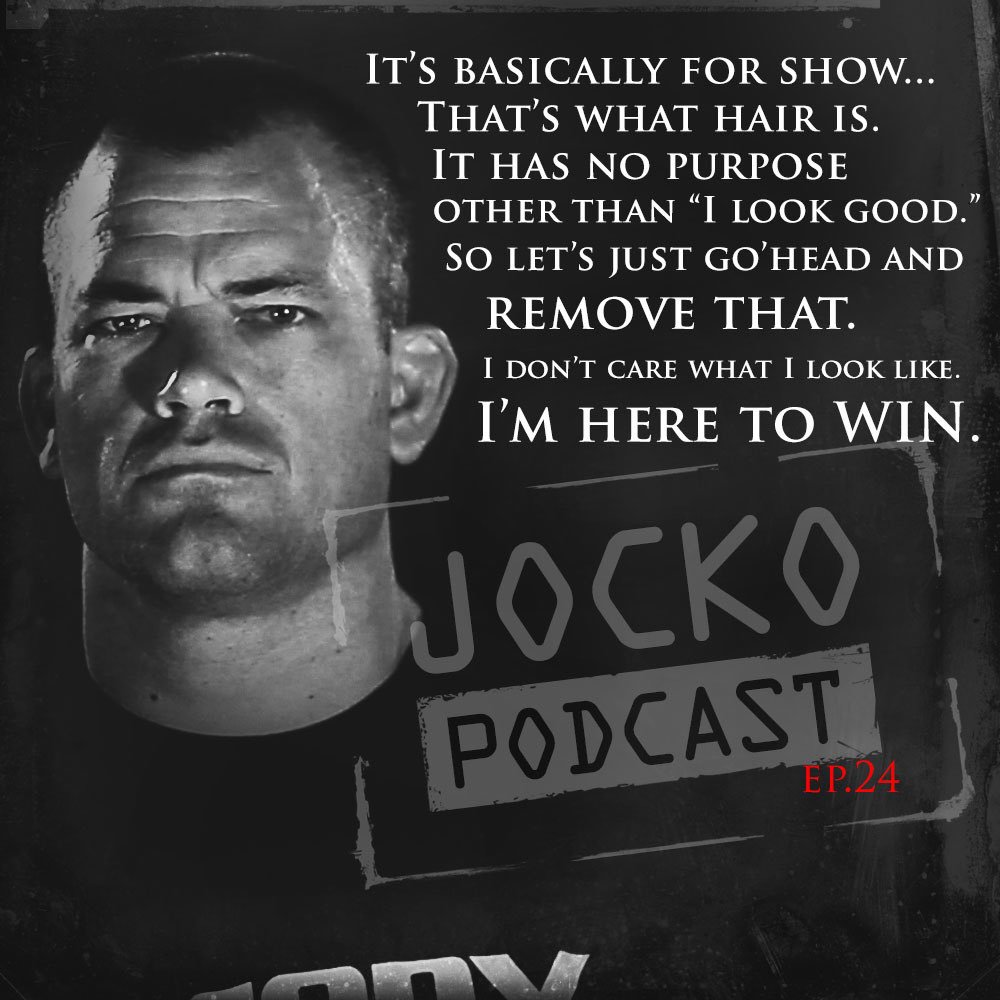
On Hair…
“It’s basically for show…that’s what hair is. It has no purpose other that ‘I look good’. So let’s just godhead and remove that. I don’t care what I look like. I’m here to win.” – Jocko Willink
Jocko Willink Quote about Hair and Winning
“There are no bad teams, only bad leaders.” – Jocko Willink
“A leader must lead but also be ready to follow.” – Jocko Willink
“A leader has nothing to prove, but everything to prove.” – Jocko Willink
“A leader must be humble but not passive; quiet but not silent.” – Jocko Willink
“Combat is reflective of life, only amplified and intensified.” – Jocko Willink
“Get After It” – Jocko Willink
“Good leaders don’t make excuses. Instead, they figure out a way to get it done.” – Jocko Willink
“Discipline equals freedom.” – Jocko Willink
“There are no bad teams, only bad leaders.” – Jocko Willink
“Extreme Ownership is a mind-set, an attitude.” – Jocko Willink
“A leader must lead but also be ready to follow.” – Jocko Willink
“There can be no leadership when there is no team.” – Jocko Willink
“Fight weak emotions with logic; fight the weakness of logic with the power of emotions “– Jocko Willink
On Aggression; “That is what aggression is to me: The unstoppable fighting spirit. The drive. The burning desire to achieve mission success using every possible tool, asset, and strategy and tactic to bring about victory. IT IS THE WILL. TO. WIN”– Jocko Willink
“GET UP. AND. GO. Take the risk, take the gamble, take the first step. Take action. And don’t let another day slip by” – Jocko Willink
“Weakness is strong. I must be stronger” – Jocko Willink
“Good. When things are going bad: Don’t get all bummed out, don’t get startled, don’t get frustrated. No. Just look at the issue and say: ‘Good'” – Jocko Willink